When a mother or baby dies in childbirth, the coroner will sometimes write a prevention of future deaths report. An analysis of these can provide valuable information about what is going wrong in maternity services, Sarah Jewell explains
Anna Foster* died in December 2022 from a massive postpartum haemorrhage (PPH), one day after a straightforward birth. The coroner’s report later stated that clinicians failed to recognise her deteriorating condition in time and that Anna’s death was “avoidable and contributed to by failures in escalation, record-keeping, communication, and monitoring.” There was also a “lack of compliance with national guidance and training.”
What happened to Anna is not unique. The failure to comply with national guidelines has been repeatedly flagged as a major concern in many recent reports investigating the shocking number of maternal and baby deaths in the UK.
A 2026 MBRRACE review showed that, in England, maternal deaths have increased by 20% since 2010, despite a government target to halve the rate of maternal mortality by 2025. The Amos Review, also published in 2026, found deep-rooted, systemic failures across the 12 NHS trusts it looked at in depth, noting that women and families were routinely ignored or dismissed. The Ockenden review of Nottingham University Hospitals NHS Trust examined the experiences of 2,500 families and over 800 staff, and concluded that 162 deaths (94 stillbirths, 62 neonatal deaths and six maternal deaths) were potentially avoidable. It also identified more than 500 cases of potentially avoidable harm to mothers and babies, including babies left with life-changing brain injuries.
Understanding the problem
Data is key to understanding why these deaths and injuries are happening. Data sets can help to measure the scale of the problem, identify why women are dying, recognise inequalities, and determine how deaths can be prevented. To understand the data better, the Birth Trauma Association worked with Carradale Futures, a healthcare advisory firm, to look at the maternity data from over 50 hospitals. Using its SOPHIA Intelligence software, an AI-powered analysis platform, Carradale Futures looked at coroners’ reports into maternal deaths.
Unexplained maternal deaths require an inquest by law, and in some cases a coroner will issue a prevention of future death (PFD) report that makes recommendations about what organisations should do to stop a similar event happening again. SOPHIA Intelligence used AI-assisted thematic analysis to investigate the PFD reports. Alba Vargas, head of business development at Carradale Futures, explains: “We looked at PFD reports from a publicly available website using a number of search terms relevant to maternity and neonatal care. We used AI-derived coding and codeframes to analyse the PFD data more consistently, more deeply and at much greater speed than traditional thematic analysis.” (A codeframe is a structured list of categories, labels or codes used to organise open-ended or unstructured survey responses.)
There are recognised limitations to using the data from PFDs: stillbirths are not investigated by a coroner; the data does not include events that lead to preventable harm or near misses; and not all of the inquests result in a PFD. They can still be a good indicator of what is going wrong, however. As Alba says: “These are stories of real people and when you read what has happened, they are heart-breaking.”
Poor risk communication and monitoring
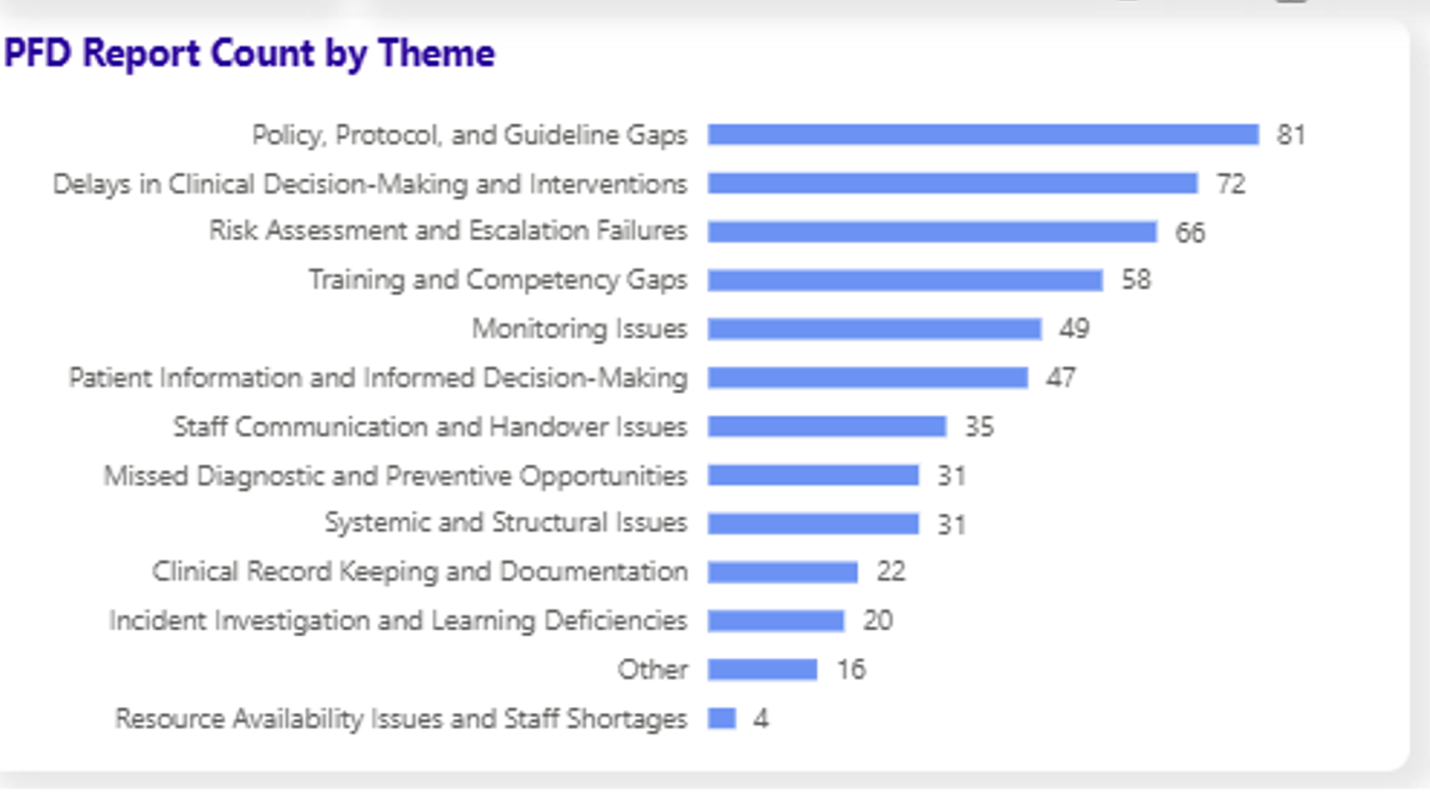
The SOPHIA Intelligence software was able to identify 13 major themes in PFDs relating to 127 maternal/neonatal deaths from 2011 to 2026. These ranged from poor risk communication to patients, monitoring issues, inadequate staff handovers, poor record keeping, and systemic issues such as reliance on incomplete records or a lack of continuity of care for mothers.
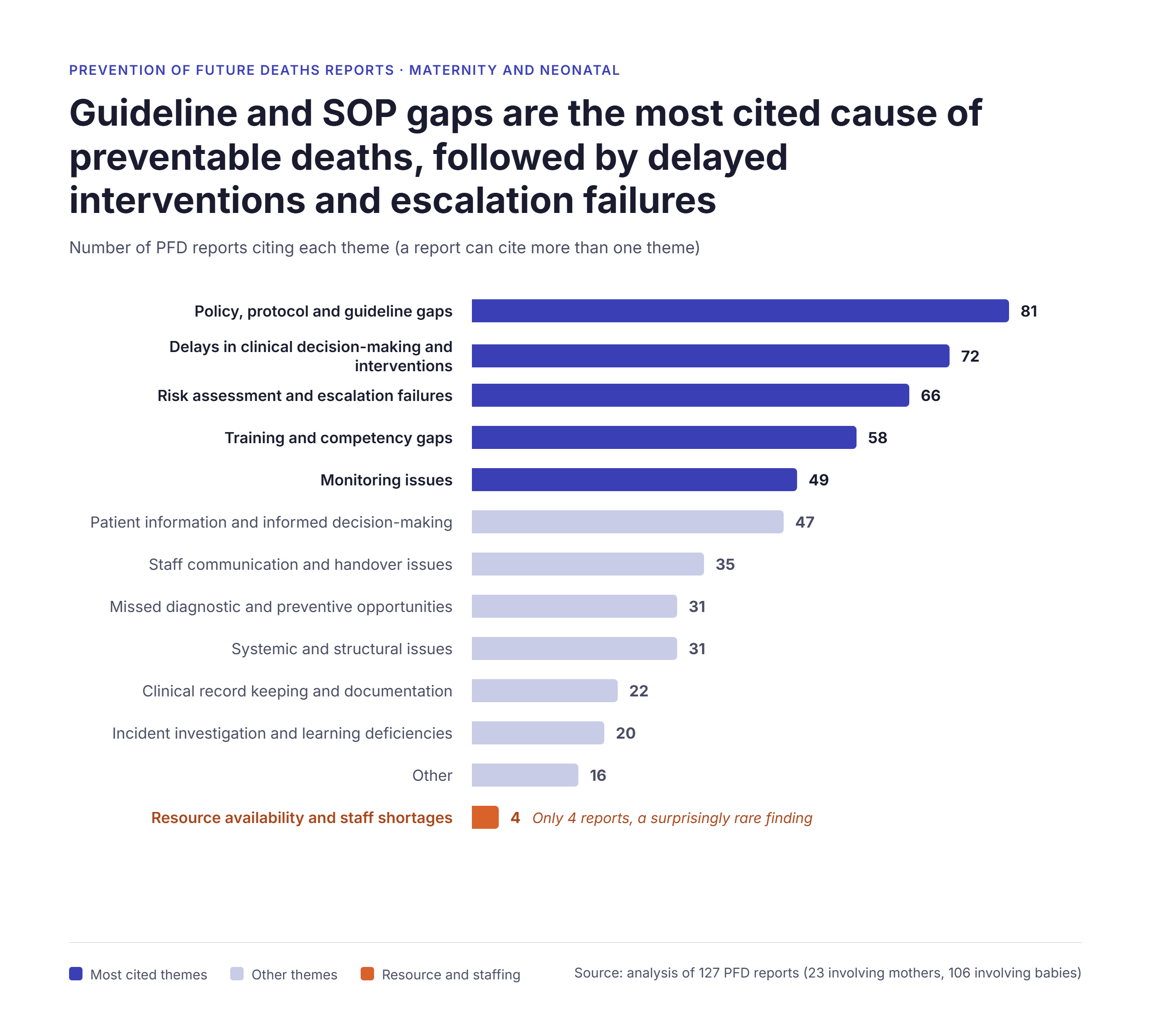
The three most common reasons cited for preventable deaths across all the PFDs, however, were:
Policy, protocol and guideline gaps
Delays in decision-making and interventions
Risk assessment and escalation failures
Between them, these accounted for 81 PFDs, or 64% of the total.
As Alba explains: “From our analysis it was clear how non-adherence to guidelines and up-to-date processes is seen by coroners as the biggest single identified contributory factor related to avoidable deaths of mothers and babies.”
A further problem, she adds, is that “if the guidance is available, it is often not clear, and process pathways are inaccessible in an emergency because they are buried deep in digital folders or the hospital’s own intranet.”
PFD reports identified cases where national guidelines were either absent or out-of-date in critical areas of care. This includes the case of Claire Morgan* who died in June 2024 from complications during a caesarean section where her head became impacted in her mother’s pelvis. The coroner’s report stated: “Claire’s death was the direct result of a resident doctor performing a manoeuvre to try to disimpact her head during a caesarean section, which caused skull fractures and intracranial haemorrhage.”
The report also noted that there was a “need for training around impacted fetal head scenarios, following the tragic death of Claire” and that “there is a risk that future deaths could occur unless action is taken”. Because of a lack of consensus on best practice, there is still no national guidance on dealing with impacted fetal head.
In 2021 baby Alfie White* died after birth. During labour, his head was tilted sideways in the birth canal, a condition known as asynclitism. The obstetrician used Kielland’s forceps to attempt to turn him, and as a result, Alfie experienced a high cervical spinal cord injury. The case highlighted the absence of national guidance on the safe use of forceps and alternative methods for managing malrotation and asynclitism. The PFD stated that “there should be increased awareness of complications associated with Kielland’s forceps use and guidance issued about the minimum number of cases per annum needed to maintain skill levels coupled with guidance for training.”
Both these cases are concerning because they are examples of procedures in maternity known to be high-risk (managing an impacted fetal head and trying to rotate a baby’s head using Kielland’s forceps) and prove the need for a skilled obstetrician to perform the manoeuvres. They show that there is a clear need for more guidance in these areas, and, as Alba explains: “In these kinds of situations there needs to be more action pathways to describe the actual steps to be taken in an emergency.”
Nine processes that require attention
The AI analysis revealed nine specific process areas and standard operating procedures (SOPs) that require attention. These ranged from escalation protocols, to cardiotocography (CTG) monitoring to placental and infection management.
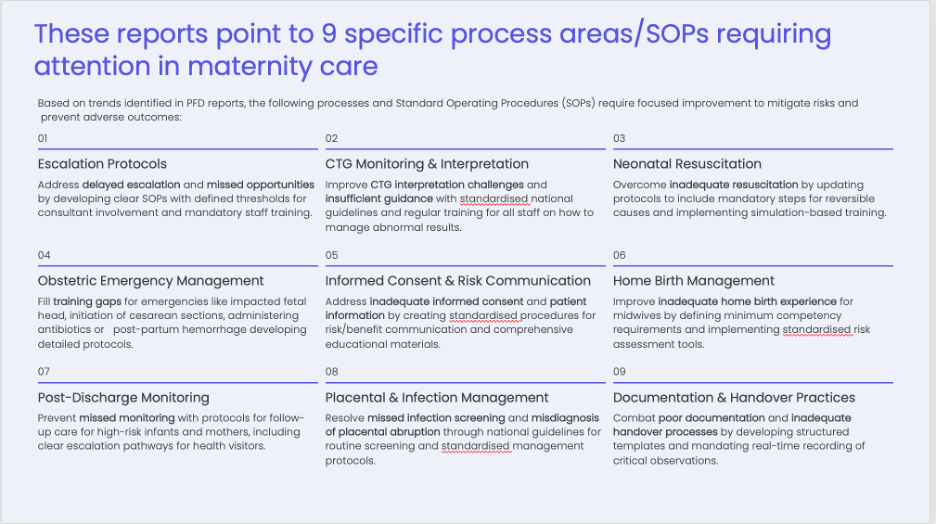
“Interestingly, the three areas at highest risk – escalation protocols, obstetric emergency monitoring and neonatal resuscitation – are also the highest risk areas identified by the maternity units we are currently working with to help them develop their process pathways,” says Alba. “Escalation protocols can sometimes be 30 pages long and very hard to read in an emergency situation – we are working with maternity units to offer more user-friendly SOPs at the point of care.”
Delays in clinical decision-making and interventions, and risk assessment and escalation failures, were mentioned in 94 PFDs. These include the report on Hannah Smith*, who died due to hypoxic ischemic encephalopathy (a brain injury caused by a lack of oxygen), which was the result of a delay in performing a caesarean section. The coroner stated that “the guidance at the time did not include asking a consultant to attend where there was a presentation outside of the staff's experience and/or skill set and/or where a significant hypoxic insult was suspected to have already happened.”
Very few of the PFDs mention staff shortages, despite the fact that there is significant coverage about this in the media, and the key issues here appear to be related to staff either not following guidelines, following them inconsistently or guidelines not being available. This kind of analysis needs to be applied to other data sets to get a fuller picture of the issues that maternity units are facing.
The data analysis concludes by recommending that efforts to improve maternity care and prevent future deaths should focus on making sure that guidelines are clear and comprehensible and that maternity units make good practice easier to follow. There should be a national/regional AI-powered database for sharing learning and updating guidelines, and more research is needed into the nonadherence to existing guidance to explore the barriers to looking at, using and understanding guidelines.
As Alba says: “In an emergency situation, easy access to guidelines is essential. For example, there should be a QR code that midwives can scan to show them immediately the action they need to take. Hospitals should be doing everything they can to maintain up-to-date guidance.” The safest hospitals, she adds, should be sharing their “protocols and guidelines nationally, as already happens in Australia, so that best practice can be adopted more widely.”
*Anna Foster, Claire Morgan, Alfie White and Hannah Smith are pseudonyms
Author note: Sarah Jewell is a freelance journalist. She has a familial connection with Carradale Futures.